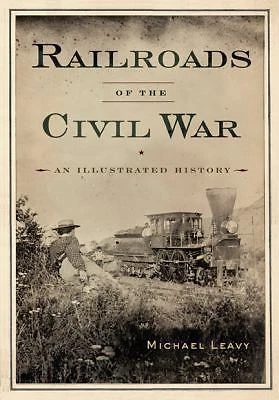
Railroads of the Civil War : An Illustrated History by Michael Leavy (2010, Hardcover)

$ 19.44

Language: English Topic: Railroads / History, United States / Civil War Period (1850-1877), Railroads / Pictorial Publisher: Westholme Publishing Book Title: Railroads of the Civil War : an Illustrated History Publication Year: 2010 Format: Hardcover Item Length: 10 in brand: Westholme Publishing Synopsis: The Photographic Record of the First Wide-Scale Mechanization of War Over the course of the first half of the nineteenth century, America would find itself following two increasingly divergent tracks: an industrialized North and an agricultural South. By 1860 railroads were firmly entrenched in our culture, reshaping our cities and steering us through the industrial age towards worldwide prominence. From sleepy post towns to the largest east coast cities, the distant hooting of the locomotive whistle drew ever closer and louder, filling listeners with fascination while brightening the eyes of profit-driven industrialists. But this admirable invention, lavishly adorned in brass and iron trimmings, was about to take on a new and deadly role. America's regional differences would result in a spectacular collision over slavery, and between 1861-1865, the nation fought a savage war. The "iron horse" became a major weapon in the first war fully dependent on railroads. Moreover railroads would escalate and prolong the war, leading to its terrible carnage. Trains were used to move troops rapidly and over great distances, completely changing military strategy. Trains were also used as mobile artillery, armed with large-caliber cannons that could pound cities and fortifications. Trains were a crucial means for supplying the armies on both sides, and it was the severing of the railway lines providing food and munitions to the Army of Northern Virginia that led to Robert E. Lee's surrender at Appomattox Court House. In Railroads of the Civil War: An Illustrated History, Michael Leavy uses compelling period photographs and drawings and a rich narrative to reevaluate and illuminate the role of railroads in the Civil War. In addition to identifying details about the various trains and ancillary equipment and buildings in the illustrations, the author explains how trains influenced the outcome of battles and the war in general., Over the course of the first half of the nineteenth century, America would find itself following two increasingly divergent tracks: an industrialized North and an agricultural South. By 1860 railroads were firmly entrenched in our culture, reshaping our cities and steering us through the industrial age towards worldwide prominence. From sleepy post towns to the largest east coast cities, the distant hooting of the locomotive whistle drew ever closer and louder, filling listeners with fascination while brightening the eyes of profit-driven industrialists. But this admirable invention, lavishly adorned in brass and iron trimmings, was about to take on a new and deadly role. America's regional differences would result in a spectacular collision over slavery, and between 1861-1865, the nation fought a savage war. The "iron horse" became a major weapon in the first war fully dependent on railroads. Moreover railroads would escalate and prolong the war, leading to its terrible carnage. Trains were used to move troops rapidly and over great distances, completely changing military strategy. Trains were also used as mobile artillery, armed with large-caliber cannons that could pound cities and fortifications. Trains were a crucial means for supplying the armies on both sides, and it was the severing of the railway lines providing food and munitions to the Army of Northern Virginia that led to Robert E. Lee's surrender at Appomattox Court House. In Railroads of the Civil War: An Illustrated History, Michael Leavy uses compelling period photographs and drawings and a rich narrative to reevaluate and illuminate the role of railroads in the Civil War. In addition to identifying details about the various trains and ancillary equipment and buildings in the illustrations, the author explains how trains influenced the outcome of battles and the war in general., In Railroads of the Civil War: An Illustrated History, Michael Leavy uses compelling period photographs and drawings and a rich narrative to reevaluate and illuminate the role of railroads in the Civil War. In addition to identifying details about the various trains and ancillary equipment and buildings in the illustrations, the author explains how trains influenced the outcome of battles and the war in general. LCCN: 2012-462602 ISBN-10: 1594161194 Item Height: 0.9 in LC Classification Number: E491 Author: Michael Leavy Number of Pages: 288 Pages Item Width: 7.5 in Illustrator: Yes Intended Audience: Trade Genre: Transportation, History gtin13: 9781594161193 Reviews: "Leavy's work shines in his deft selection of images, many of which have never been published before."-- Civil War Books and Authors "This is a fantastic book about the railroads of the Civil War. It will bring joy and happiness to any person that has an interest in railroads. This is a definite 'must have' for every person interested in the American Civil War."-- Lone Star Book Review ISBN-13: 9781594161193

Description

Delve into the pivotal role of railroads during the Civil War era with Michael Leavy's "Railroads of the Civil War: An Illustrated History." This hardcover edition, signed by the author, offers a comprehensive visual and narrative chronicle of this critical period in American history. Published by Westholme Publishing in 2010, this book is a treasure trove for enthusiasts of transportation and historical artifacts. With 288 pages of detailed content, the book is a substantial resource measuring 10 inches in length, 7.5 inches in width, and 0.9 inches in height. It's a must-have for collectors with an interest in railroads, pictorial histories, and the Civil War period. The ISBN is 978161-400-015-3 and the EAN is 9781614000153. Questions, just email. Shipping is $6.00 anywhere in the U.S.