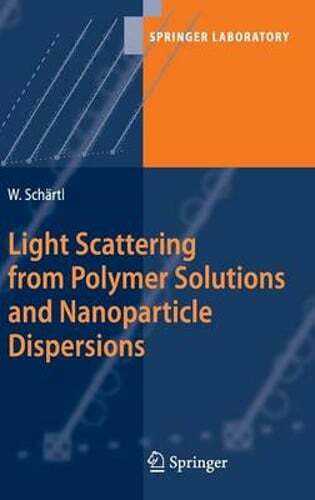
Light Scattering Techniques for Polymer Solutions and Nanoparticle Dispersions by Wolfgang Schartl Hardcover

$ 65.11

Intended Audience: Scholarly & Professional Synopsis: Light scattering is a very powerful method to characterize the structure of polymers and nanoparticles in solution. Recent technical developments have strongly enhanced the possible applications of this technique, overcoming previous limitations like sample turbidity or insufficient experimental time scales. However, despite their importance, these new developments have not yet been presented in a comprehensive form. In addition, and maybe even more important to the broad audience, there lacks a simple-to-read textbook for students and non-experts interested in the basic principles and fundamental techniques of light scattering. As part of the Springer Laboratory series, this book tries not only to provide such a simple-to-read and illustrative textbook about the seemingly very complicated topic of light scattering from polymers and nanoparticles in dilute solution, but also intends to cover some of the newest technical developments in experimental light scattering., Light scattering is a very powerful method for characterizing the structure of polymers and nanoparticles in solution. As part of the Springer Laboratory series, this book provides a simple-to-read and illustrative textbook probing the seemingly very complicated topic of light scattering from polymers and nanoparticles in dilute solution, and goes further to cover some of the latest technical developments in experimental light scattering. Subject: Mechanics / Fluids, Materials Science / General, Physics / Condensed Matter, Physics / Polymer, Physics / Optics & Light, Nanotechnology & Mems Format: Hardcover Series: Springer Laboratory Ser. ISBN-13: 9783540719502 Publisher: Springer Berlin / Heidelberg gtin13: 9783540719502 brand: Springer Berlin / Heidelberg Number of Volumes: 1 vol. ISBN-10: 3540719504 Table Of Content: Fundamental Concepts.- Experimental Setups.- Commercial Light Scattering Instruments.- Sample Preparation.- Selected Examples of Light Scattering Experiments.- Sample Cells, Filters and Solvents.- Further Reading. LC Classification Number: TA455.P58-.P585 Author: Wolfgang Schartl Language: English Item Height: 0.2 in Illustrated: Yes Item Weight: 17 Oz Item Length: 9.3 in Subject Area: Technology & Engineering, Science Type: Textbook Publication Year: 2007 Item Width: 6.1 in Publication Name: Light Scattering from Polymer Solutions and Nanoparticle Dispersions Number of Pages: Xiv, 191 Pages

Description

Light scattering is a very powerful method to characterize the structure of polymers and nanoparticles in solution. Recent technical developments have strongly enhanced the possible applications of this technique, overcoming previous limitations like sample turbidity or insufficient experimental time scales. However, despite their importance, these new developments have not yet been presented in a comprehensive form. In addition, and maybe even more important to the broad audience, there lacks a simple-to-read textbook for students and non-experts interested in the basic principles and fundamental techniques of light scattering. As part of the Springer Laboratory series, this book tries not only to provide such a simple-to-read and illustrative textbook about the seemingly very complicated topic of light scattering from polymers and nanoparticles in dilute solution, but also intends to cover some of the newest technical developments in experimental light scattering.
  1. This book is a must-have for researchers studying polymers and nanoparticles! Wolfgang Schartl expertly covers modern light scattering techniques, making complex concepts accessible. The detailed explanations and practical insights help bridge the gap between theory and application. Whether you're dealing with turbid samples or fast processes, this guide offers valuable solutions. A well-organized, thorough resource that saves time and enhances experimental accuracy. Highly recommended for anyone in materials science or soft matter research!

    Charlie Evans