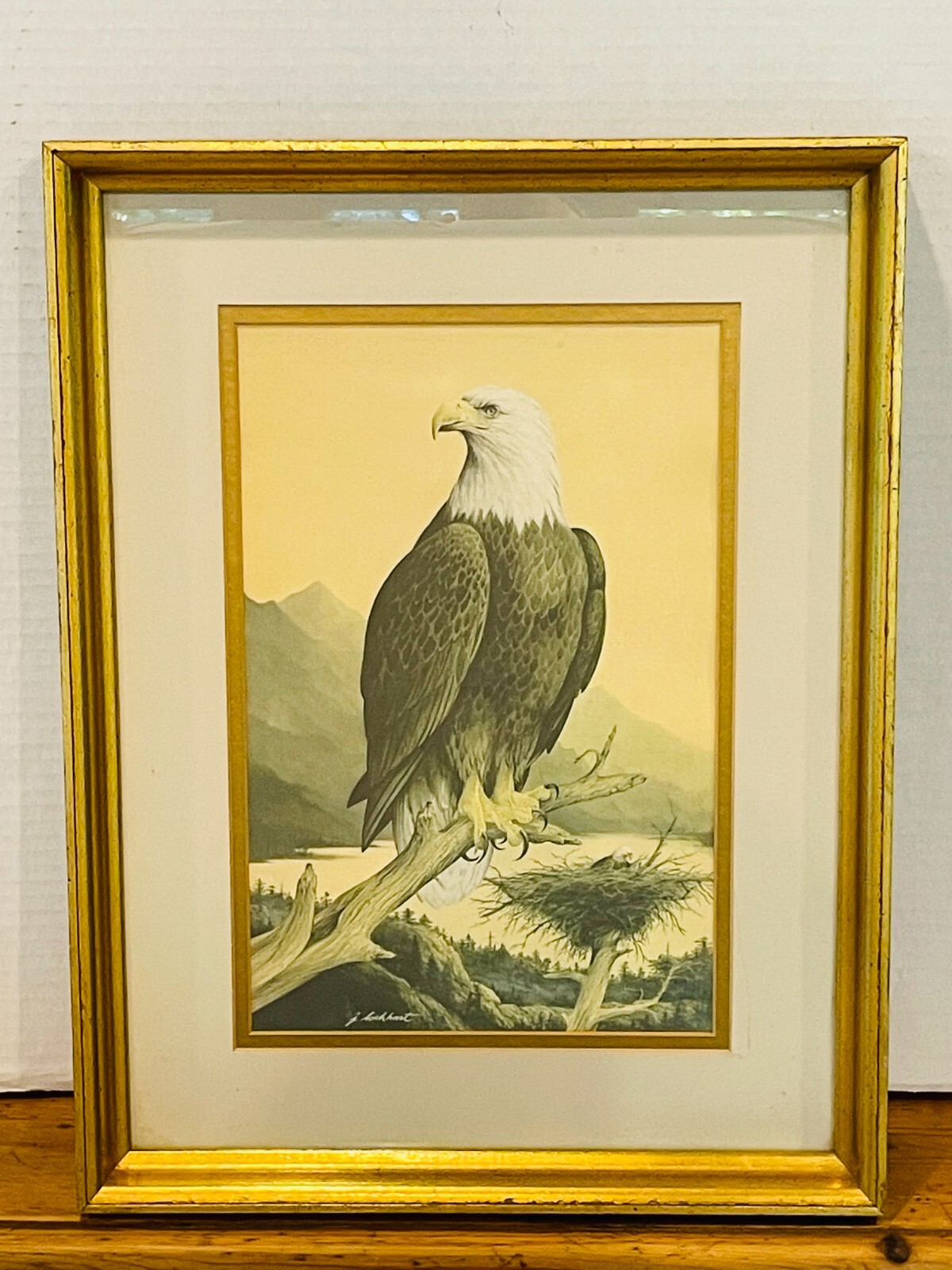




James Lockhart Vintage Bald Eagle "Guarding the Nest" Framed & Matted 19x15"
$ 26.38
Description
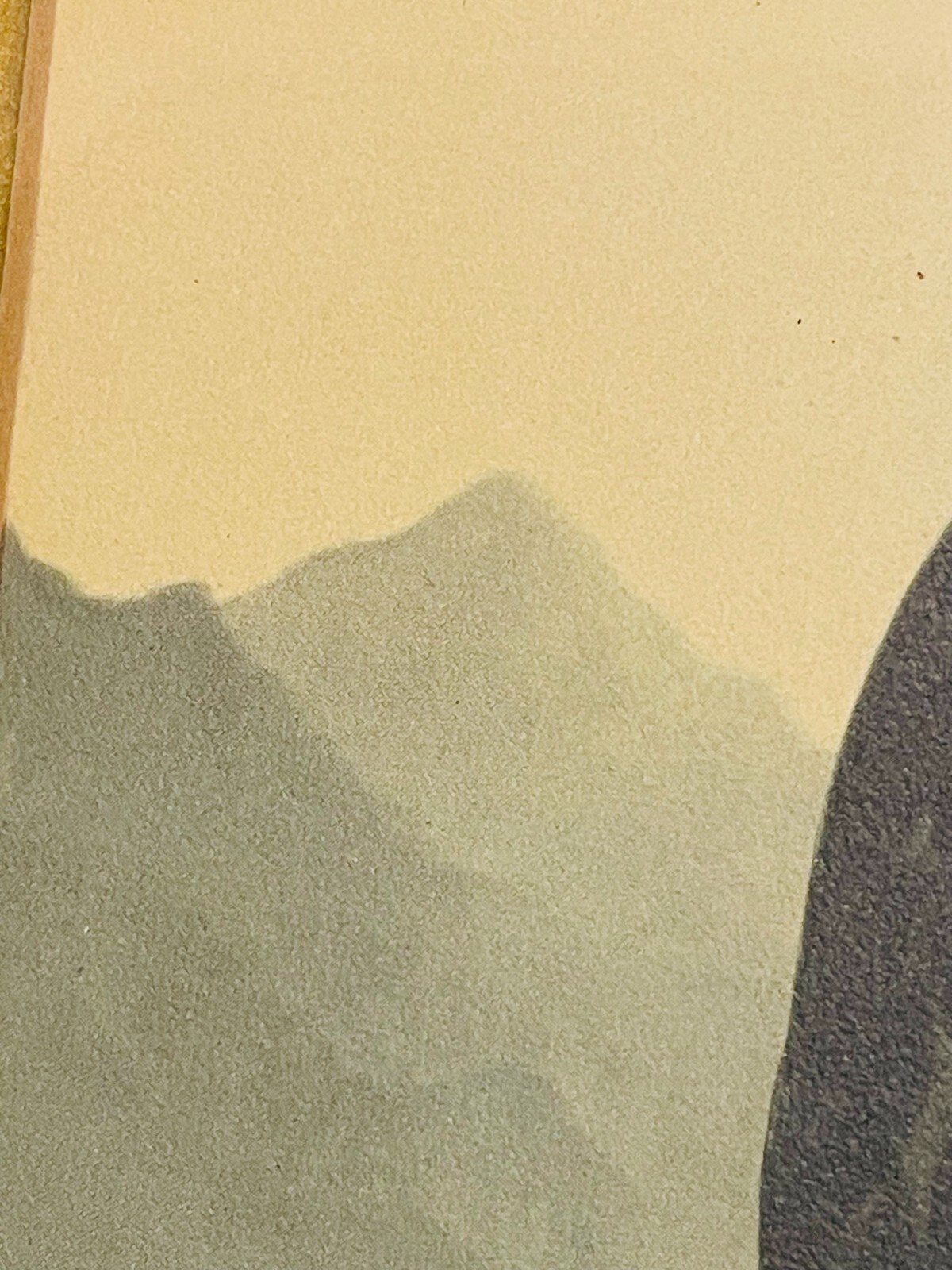
James Lockhart Vintage Bald Eagle "Guarding the Nest" Framed & Matted 19x15". In fall 1930, Lockhart entered the School of Arts and Sciences at the University of Arkansas. Lockhart was active in fraternity life and served as an art editor for the 1931 Razorback yearbook. Lockhart’s father, unconvinced that his son could make a living through art, insisted that Lockhart work at least a year before art school. James Lockhart Framed Bald Eagle Print "Guarding the Nest" Vintage 1960 Gold Frame Matted Size: 19.5" x 15" Very Good Condition- slight stain on lower right of mat (see close up) About the Artist: James Leland Lockhart was one of America’s foremost nature and wildlife artists and a notable illustrator during the second half of the twentieth century. His paintings are in many museums, including the Smithsonian Institution, and his commercial works were printed in leading national publications for clients such as Wrigley, Coca-Cola, and General Electric. James Lockhart was born on September 26, 1912, in Sedalia, Missouri, to Leland Lockhart and Nell Cockrill Lockhart. The family returned to its home in where Leland Lockhart worked as a Missouri Pacific Railroad engineer. An only child in the backcountry of Arkansas, Lockhart spent much of his time roaming, hunting, and fishing, all the while observing and sketching the abundant wildlife. In fall 1930, Lockhart entered the School of Arts and Sciences at the University of Arkansas. He attended classes there through the spring semester of 1932. Lockhart was active in fraternity life and served as an art editor for the 1931 Razorback yearbook. Lockhart’s father, unconvinced that his son could make a living through art, insisted that Lockhart work at least a year before art school. Lockhart found a job drawing cotton acreage maps for a New Deal project created in response to the Great Depression. During a break, Lockhart, a habitual doodler, sketched the likeness of President Franklin Delano Roosevelt from a photograph published in the Arkansas Gazette. Lockhart’s supervisor saw his drawing and sent it to the White House. Soon, a handwritten response came from President Roosevelt thanking Lockhart for the sketch and encouraging him to pursue his artistic ambitions. In 1934, Lockhart moved to Chicago, Illinois, and enrolled in the American Academy of Art. In the evenings, Lockhart attended the Art Institute of Chicago and studied under the well-known artist and teacher Edmund Giesbert. James Lockhart married Marjorie Faye “Toby” Tobias on June 10, 1939. They had two children. Lockhart’s first big career break came when his drawings were chosen for the Wrigley Company in Chicago. Coronet magazine then commissioned a series of his illustrations of the cotton-growing regions of southeastern Arkansas. Coronet followed that series with Lockhart’s first cover. Other assignments soon came from national publications such as Saturday Evening Post, Liberty, Collier’s, Sports Afield, True, and Country Gentleman. Lockhart’s portfolio of champion field dogs for Sports Afield was, according to the magazine editor, the most popular in the publication’s history. A painting from a series of small birds and animals received the Artist Guild of Chicago Award for Best Painting of 1957. In 1970, Lockhart was offered two opportunities to produce his art on porcelain china, a medium he had little experience using. The first project came from Pickard China, America’s oldest fine-china company, which envisioned a limited edition series that utilized Lockhart’s wild-bird paintings. The series began with eight collector’s plates. Each piece had the artist signature on the front with a 23-carat-gold design bordering the art. President Gerald Ford displayed in the Oval Office Lockhart’s American Bald Eagle from the 1974 addition to Pickard’s Wildlife Series. Global collectors continue to follow the Pickard porcelain art that reproduced seventeen of Lockhart’s paintings. The second undertaking came when the Jim Beam Company, in collaboration with Regal China Company, wanted to produce two platters made with Lockhart’s art to give as holiday gifts. Two of Lockhart’s designs, the Woodcock and Wood Duck, were shown on the platters, later labeled the “Best Executive Gift of the Year” by Fortune magazine. Between 1970 and 1998, the Jim Beam Company also created and sold limited-edition decanters that featured Lockhart’s paintings. While most of Lockhart’s compositions focused on wildlife, he made substantial artistic contributions in other realms of Americana. The Container Corporation of America (CCA), the world’s largest cardboard manufacturer, began an advertising campaign incorporating contemporary fine art. Among CCA’s early ads was the 1947 “United States Series” that commissioned artists native to each state to portray the character and qualities of their state. Lockhart was selected to represent Arkansas, and his painting Arkansas, an oil and pencil on paperboard sheet, pictures a farmer behind two mules cultivating a cotton field. Lockhart’s CCA advertisement was published in Fortune, Time, and Life magazines. The original painting is in the Smithsonian Museum of American Art in Washington DC. The National Baseball Hall of Fame and Museum in Cooperstown, New York, purchased an original Lockhart painting, casein on board, first printed as the June 1950 cover of Elks Magazine. The piece depicts a young boy (modeled on Lockhart’s son) catching a ball hit into the stands while those around him were diving for safety. Another Lockhart commission came from the Lincoln Fellowship of Pennsylvania, a partner organization of the Gettysburg National Military Park and Museum of the American Civil War. Lockhart’s painting shows Abraham Lincoln as he prepared the Gettysburg Address. Lockhart was active in many conservation groups such as the International Crane Foundation, the Nature Conservancy, and the National Parks Conservation Association. He was on the governing boards of Chicago’s Shedd Aquarium and the Brookfield Zoo and was a national trustee for Ducks Unlimited, Inc. In 1971, at Lockhart’s urging, Ducks Unlimited began a national fundraising program to produce and sell limited-edition art prints. Reproductions made from Lockhart’s painting of the green-winged teal raised more than $150,000. Lockhart supported the Lake Forest Illinois Open Lands Association from its founding in 1967. In 1998, the organization opened the Lockhart Family Nature Center in recognition of Lockhart’s commitment to land and wildlife preservation. Lockhart wrote and illustrated three books. The first was a children’s book, Porkey: An Arkansas Razorback, published in 1939. The others were collections of his works: Portraits of Nature, printed in 1967 by Crown Publisher, and followed in 1979 by Wild America, printed by Thomas Nelson Publishers. In addition, Lockhart released numerous portfolios of game birds, cats, and waterfowl. Lockhart was a member of the Art Guild of Chicago and the Arts Club of Chicago. He was elected a Life Fellow by the International Institute of Arts and Letters, Kreuzlingen, Switzerland. He also established Walden Press, a publishing company that specialized in art prints, and co-founded a gourmet snacks company, Market Square Food, that utilized his art in packaging. Lockhart founded a consulting enterprise that developed new lithography techniques for color separation. His standardization procedure revolutionized the four-color offset printing process for high-tech printing houses such as Newman-Rudolph Lithographing and Sleepeck Printing of Chicago. Throughout his long career, Lockhart earned many national awards and recognitions. He won the National Graphic Arts Award in 1968 and 1970 and the Printing Industry Award in 1970 and 1971. Three times between 1978 and 1982, Lockhart’s wildlife calendars won the Award of Merit from Mead Paper Company. Lockhart was named Illinois Artist of the Year in 1992 and honored by a show, Rooted in Nature, at the Illinois State Museum. In 1998, Lockhart exhibited at the Durand Art Gallery to benefit Lake Forest Open Lands. A display of his work was held at Chicago’s prestigious Field Museum of Natural History in 2002, the only time that museum had honored a living artist. When Lockhart died on February 11, 2005, the drawing left on his work space was of a white buffalo, the legendary symbol of hope and good things to come. Lockhart was buried in Lake Forest, Illinois, a suburb of Chicago.