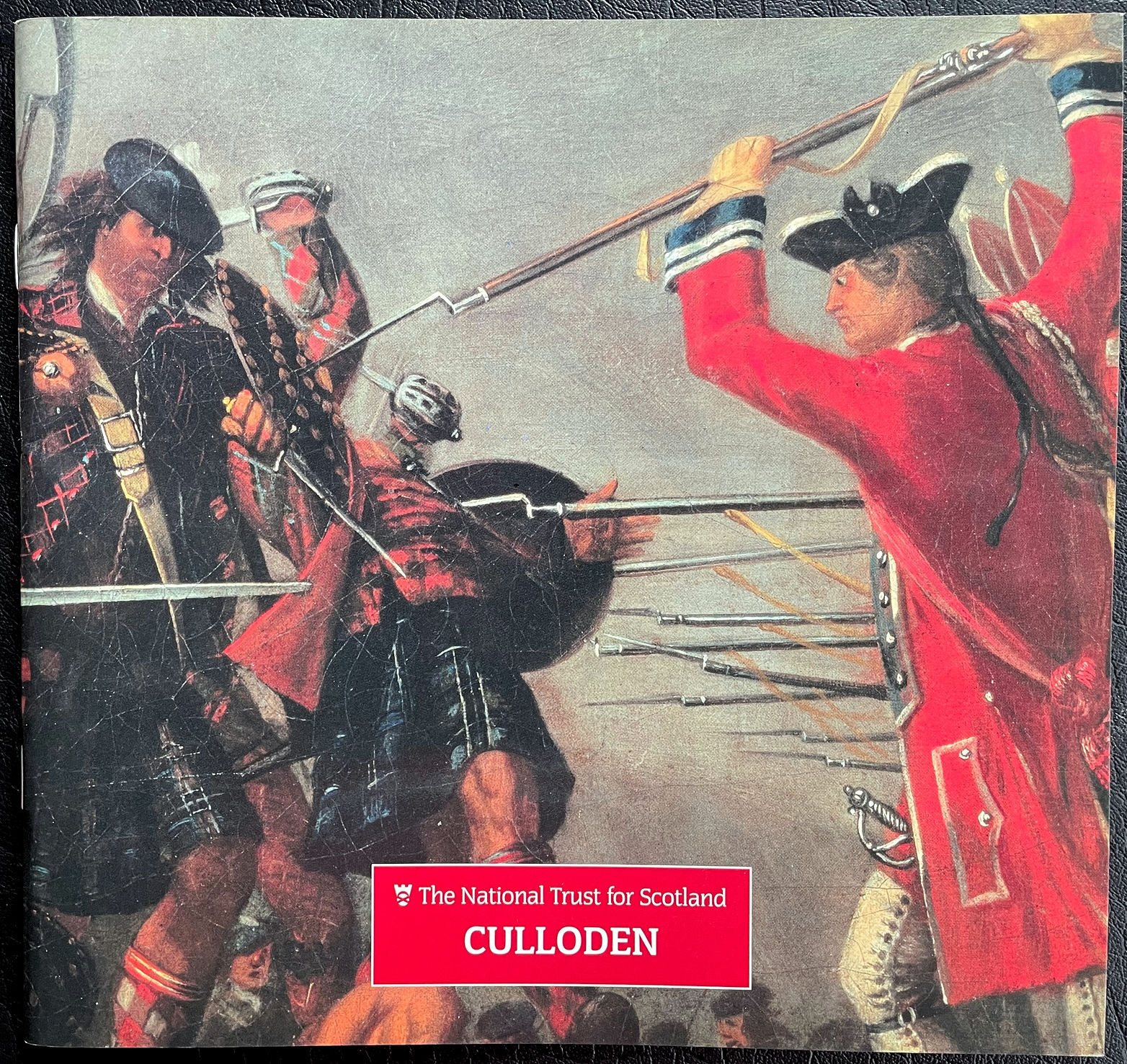

Culloden 1746 Jacobite Uprising Scotland Prince Charles Cumberland Prestonpans
$ 2.62
Description
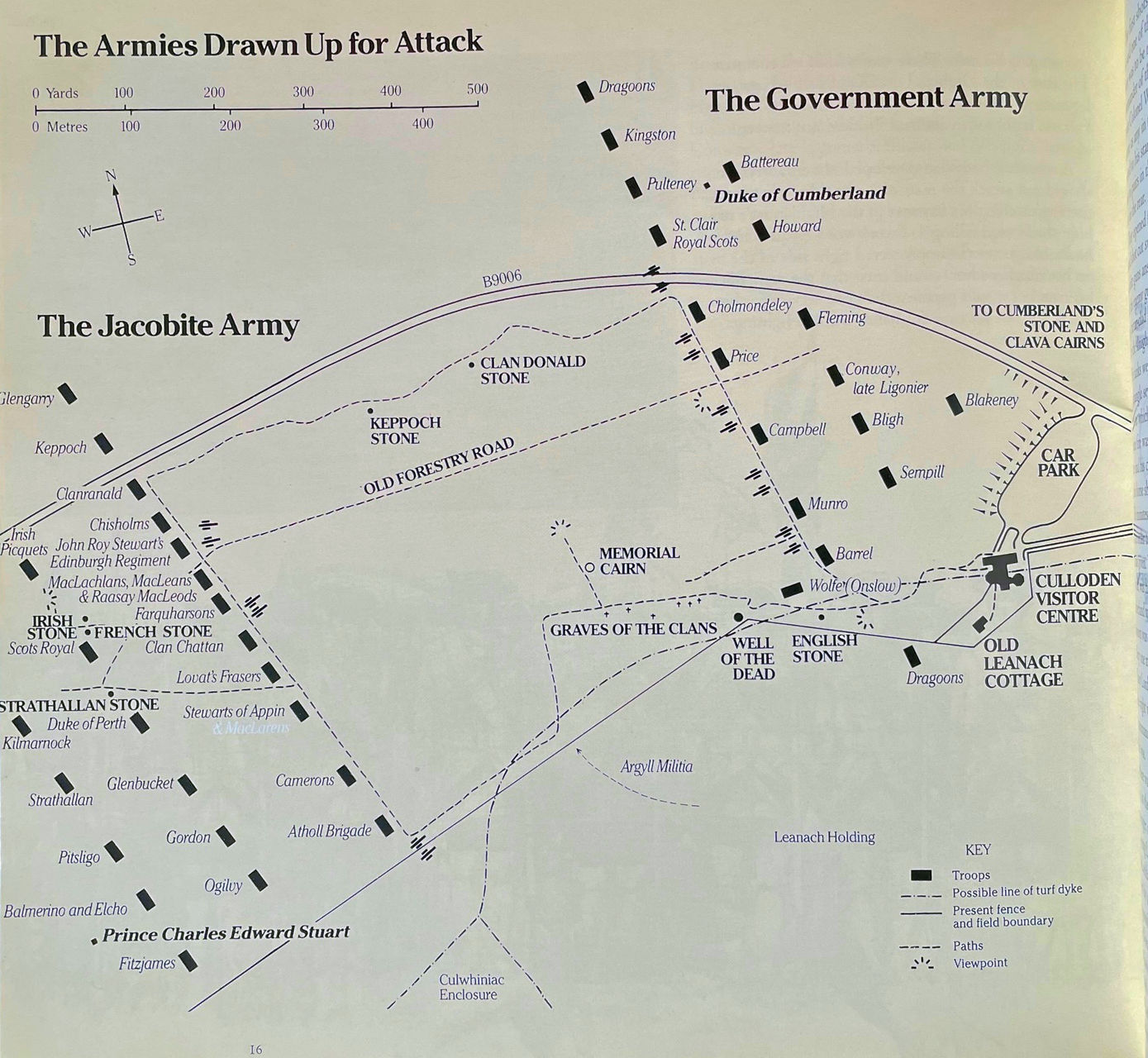
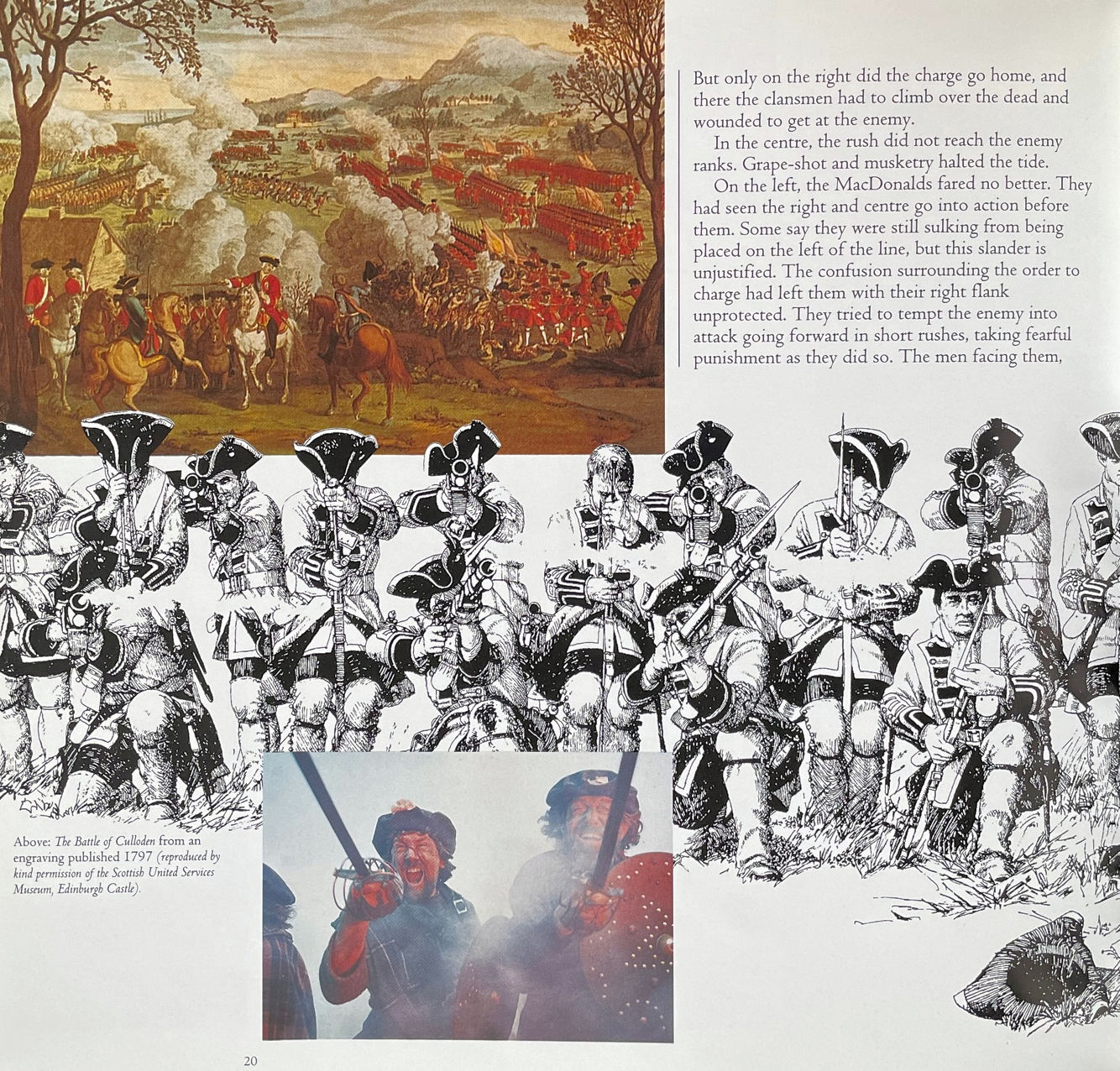
CULLODEN 1746 JACOBITE UPRISING SCOTLAND PRINCE CHARLES CUMBERLAND PRESTONPANS. The Battle of Culloden was the final confrontation of the Jacobite rising of 1745. On 16 April 1746, the Jacobite forces of Charles Edward Stuart were decisively defeated by Hanoverian forces commanded by William Augustus, Duke of Cumberland, near Inverness in the Scottish Highlands. Shipping CULLODEN 1746 JACOBITE UPRISING SCOTLAND PRINCE CHARLES CUMBERLAND PRESTONPANS CULLODEN 1746 JACOBITE UPRISING SCOTLAND PRINCE CHARLES CUMBERLAND PRESTONPANS FALKIRK THE NATIONAL TRUST FOR SCOTLAND SOFTBOUND BOOK --------------------------------------------------------------------------------- Additional Information from Internet Encyclopedia The Battle of Culloden was the final confrontation of the Jacobite rising of 1745. On 16 April 1746, the Jacobite forces of Charles Edward Stuart were decisively defeated by Hanoverian forces commanded by William Augustus, Duke of Cumberland, near Inverness in the Scottish Highlands. Queen Anne, the last monarch of the House of Stuart, died in 1714, with no living children. Under the terms of the Act of Settlement 1701, she was succeeded by her second cousin George I of the House of Hanover, who was a descendant of the Stuarts through his maternal grandmother, Elizabeth, a daughter of James VI and I. Raising an army consisting mostly of Scottish clansmen along with smaller units of Irish and Englishmen from the Manchester Regiment, Charles' efforts initially met with success and at one point began to threaten London. However, a series of events forced the army's return to Scotland, where they were soon pursued by an army raised by the Duke of Cumberland. The two forces eventually met at Culloden, on terrain that made the highland charge difficult and gave the larger and well-armed British forces the advantage. The battle lasted only an hour, with the Jacobites suffering a bloody defeat. Between 1,500 and 2,000 Jacobites were killed or wounded in the brief battle. In contrast, only about 300 government soldiers were killed or wounded. The Hanoverian victory at Culloden halted the Jacobite intent to overthrow the House of Hanover and restore the House of Stuart to the British throne; Charles Stuart never again tried to challenge Hanoverian power in Great Britain. The conflict was the last pitched battle fought on British soil. The battle and its aftermath continue to arouse strong feelings: the University of Glasgow awarded the Duke of Cumberland an honorary doctorate, but many modern commentators allege that the aftermath of the battle and subsequent crackdown on Jacobitism were brutal, and earned Cumberland the sobriquet "Butcher". Efforts were subsequently made to further integrate the comparatively wild Scottish Highlands into the Kingdom of Great Britain; civil penalties were introduced to weaken Gaelic culture and undermine the Scottish clan system. On 23 July, 1745 Charles Edward Stuart landed on Eriskay in the Western Islands in an attempt to reclaim the throne for Great Britain for his exiled father James, accompanied only by the "Seven Men of Moidart". Most of his Scottish supporters advised he return to France, but enough were eventually persuaded and the rebellion was launched at Glenfinnan on 19 August. The Jacobite army entered Edinburgh on 17 September and James was proclaimed King of Scotland the next day. On 21 September, a government force was defeated at the Battle of Prestonpans; the London government now recalled the Duke of Cumberland, the King's younger son and commander of the British army in Flanders, along with 12,000 troops. The Prince's Council, a committee formed of 15-20 senior leaders, met on 30 and 31 October to discuss plans to invade England. The Scots wanted to consolidate their position and although willing to assist an English rising or French landing, they would not do it on their own. For Charles, the main prize was England; he argued removing the Hanoverians would guarantee an independent Scotland and assured the Scots that the French were planning to land in Southern England, while thousands of English supporters would join once across the border. Despite their doubts, the Council agreed to the invasion on condition the promised English and French support was forthcoming and the Jacobite army entered England on 8 November. They captured Carlisle on 15 November, then continued south through Preston and Manchester, reaching Derby on 4 December. There had been no sign of a French landing or any significant number of English recruits, while they risked being caught between two armies, each one twice their size; Cumberland's, advancing north from London, and Wade's moving south from Newcastle upon Tyne; despite Charles' opposition, the Council was overwhelmingly in favour of retreat and turned north the next day. Apart from a minor skirmish at Clifton Moor, the Jacobite army evaded pursuit and crossed back into Scotland on 20 December. Entering England and returning was a considerable military achievement and morale was high; Jacobite strength increased to over 8,000 with the addition of recruits from the Frasers, Mackenzies and Gordons, as well as Scottish and Irish regulars in French service. French-supplied artillery was used to besiege Stirling Castle, the strategic key to the Highlands. On 17 January, the Jacobites dispersed a relief force under Henry Hawley at the Battle of Falkirk Muir, although the siege made little progress. On 1 February, the siege of Stirling was abandoned and the Jacobites retreated to Inverness. Cumberland's army advanced along the coast and entered Aberdeen on 27 February; both sides halted operations until the weather improved. Several French shipments were received during the winter but the Royal Navy's blockade led to shortages of both money and food; when Cumberland left Aberdeen on 8 April, Charles and his officers agreed giving battle was their best option. The Jacobite Army is often assumed to have been largely composed of Gaelic-speaking Catholic Highlanders whereas in reality some of its most effective units were recruited from the Lowlands. By 1745, Catholicism was confined to remote areas of the Highlands and Islands and large numbers of those who joined the Rebellion were Non-juring Episcopalians. Finally, while predominantly Scottish, it contained English recruits plus significant numbers of French, Scottish and Irish professionals in French service. Regardless of nationality, regulars were treated as Prisoners of War and exchanged, rather than being tried for treason. One problem for the Jacobites was the difference between clan warfare, which was short-term and often based on raiding, versus military operations, which required greater professionalism and training; even the colonels of the Macdonald regiments of Clanranald and Keppoch considered their men to be uncontrollable. A typical clan regiment was made up of a small minority of gentlemen (tacksmen) who would bear the "clan name", and under them the common soldiers or "clansmen" who bore a mixed bag of names. The clan gentlemen formed the front ranks of the unit and were more heavily armed than their impoverished tenants who made up the bulk of the regiment. Because they served in the front ranks, the gentlemen suffered higher proportional casualties than the common clansman. The gentlemen of the Appin Regiment suffered one quarter of those killed, and one third of those wounded from their regiment. The Jacobites started the campaign poorly armed; at Prestonpans, many were armed only with swords, Lochaber axes, pitchforks and scythes. Although Highlanders are often pictured equipped with a broadsword, targe and pistol, this normally applied to only officers or gentlemen. After Culloden, Cumberland reported 2,320 firelocks were recovered from the battlefield, but only 190 broadswords; this implies that of the roughly 1,000 Jacobites killed at Culloden, no more than one fifth carried a sword. As the campaign progressed, supplies from France improved their equipment considerably and by the time of Culloden, many were equipped with 0.69 in (17.5 mm) calibre French and Spanish firelocks. During the latter stage of the campaign, the Jacobites were reinforced by French regulars, many drawn from the French Irish Brigade, including Fitzjames's Horse and Irish volunteers or Picquets. The majority were Irish born, with the exception of the Royal Écossais, a Scottish unit in French service, which was led by John and Louis Drummond, grandsons of the Earl of Melfort, Secretary of State to James II & VII. Lists of prisoners at Marshalsea, Berwick and prison interviews conducted by Captain Eyre show some were English born, claiming to have been press-ganged or seized as prisoners on British ships. Fitzjames's Horse was the only Jacobite cavalry unit to fight the whole battle on horseback. Around 500 Irish Picquets in the French army fought in the battle, some of whom were thought to have been press-ganged from 6th (Guise's) Foot taken at Fort Augustus. The Royal Écossais also contained deserters, and John Drummond attempted to raise a second battalion after the unit had arrived in Scotland. The Jacobite artillery is generally regarded as playing little part in the battle, all but one of the cannon being 3-pounders. The Kingdom of Great Britain government army at the Battle of Culloden was made up of infantry, cavalry, and artillery. Of the army's 16 infantry battalions present, four were Scottish units and one was Irish. The officers of the infantry were from the upper classes and aristocracy, while the rank and file were made up of poor agricultural workers. On the outbreak of the Jacobite rising, extra incentives were given to lure recruits to fill the ranks of depleted units. For instance, on 6 September 1745, every recruit who joined the Guards before 24 September was given £6, and those who joined in the last days of the month were given £4. Regiments were named after their colonel. In theory, an infantry regiment would comprise up to ten companies of up to 70 men. They would then be 815 strong, including officers. However, regiments were rarely anywhere near this large, and at the Battle of Culloden, the regiments were not much larger than about 400 men. The government cavalry arrived in Scotland in January 1746. They were not combat experienced, having spent the preceding years on anti-smuggling duties. A standard cavalryman had a Land Service pistol and a carbine. However, the main weapon used by the British cavalry was a sword with a 35-inch blade. The Royal Artillery vastly out-performed their Jacobite counterparts during the Battle of Culloden. However, up until this point in the campaign, the government artillery had performed dismally. The main weapon of the artillery was the 3-pounder. This weapon had a range of 500 yards (460 m) and fired two kinds of shot: round iron and canister. The other weapon used was the Coehorn mortar. Shipping & Handling Back to Top US Shipping (FREE) USPS Media Mail® International Shipping Please check eBay's Shipping & Payment tab USPS First-Class Mail International (Worldwide) USPS First-Class Mail International (Canada) FREE scheduling, supersized images and templates. Get Vendio Sales Manager. Make your listings stand out with FREE Vendio custom templates! FREE scheduling, supersized images and templates. Get Vendio Sales Manager. Over 100,000,000 served. Get FREE counters from Vendio today!